The Christmas Designed in July
Every December, shopping centres share the same flow of families. It goes to the one where Christmas works as an environment: the reason a family chooses that centre and comes back. An environment like that takes three to four months to build. So the decision about December is taken in summer.
- Author
- Konstantin Burtsev, ENTORA
- Date
- Reading
- 5 min
- Topics
- shopping-centres · christmas · placemaking · recognition
While the City Is Still in July, December Is Already Being Decided
In December, every shopping centre in the city lines up together. The same flow of families, the same weekends, the same question in every head: where to go for the presents and the mood. Shopfronts look alike, the discounts look alike, and this year the garlands are red and gold again, everywhere at once.
The flow goes to the centre where Christmas stops being decoration and becomes an environment. An environment a family chooses this address for, spends the whole evening in and returns to a week later. And an environment of that order simply cannot be bought in November. It is designed in summer, when the holiday is still six months off and no one but us is thinking about December yet.
What a Family Actually Chooses in December
A family in December is not there for the goods. The goods are identical across three centres on one ring road. They come for the evening: for a child to stop still under something large and glowing, for a shot worth posting, for a reason to linger over dinner once the shopping is done.
This is the asset of December. A centre that has given a family that evening earns more time inside, a higher average spend, more word of mouth and one simple reflex for the whole season: 'let's go where it was beautiful last year'. Where the garland came from a catalogue, what's left is passing footfall and silence on social media.
Decoration Is Hung. An Environment Is Built With Intent
The gap between two Decembers has little to do with the lighting budget. It comes down to whether there is a thought behind the light.
Decoration lives by the logic of a catalogue: choose the items, hang them across the floor plate, photograph it by the first of December. It covers the box marked 'we're festive too' and fades from memory by January. An environment lives by the logic of an image: it holds one idea you can put into words, and one signature piece that everything else gathers around. A guest walks in and knows straight away where they are and why they want to stay.
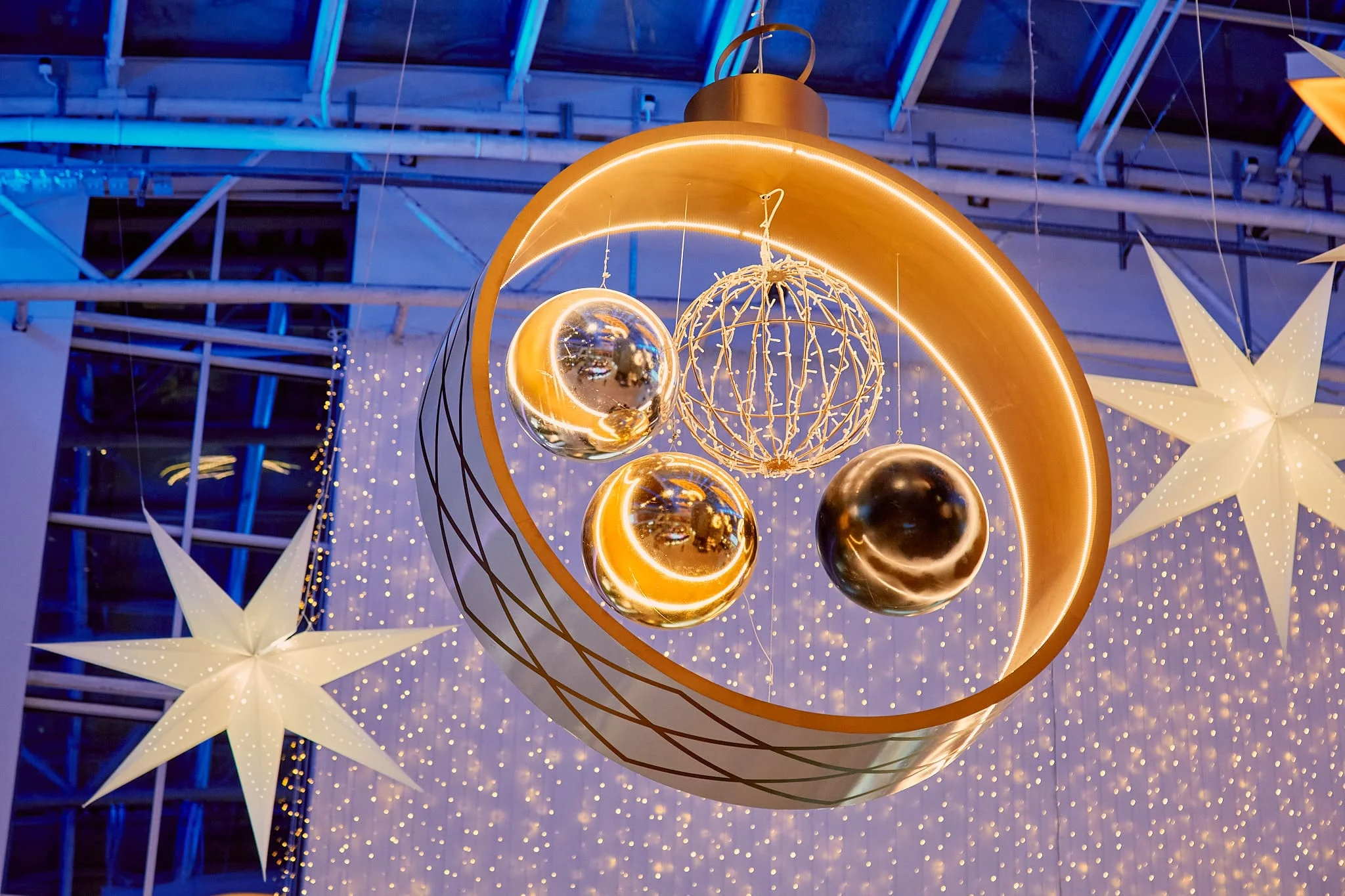
The signature piece holds the space with one clear image and leaves air around it. A golden crescent moon beneath the roof. A tree of light that draws the whole atrium in. A suspended composition that makes a guest tilt their head back and reach for their phone. In a Schofields survey (2017, more than 1,000 Britons aged 18-33), people named a place's 'Instagrammability' as the number-one factor in choosing where to go. In December that factor runs at its peak: people go out of their way to find where to take the shot of the season, and they go as a family.
Why This Is a July Decision, Not an October One
A real environment is built in four movements, and each one takes its own time.
First, the meaning: what this centre says to its city this winter, what image the atrium holds, how it stands apart from the one next door. Then design and engineering: the signature piece is drawn around the real spans, the roof and the suspension points, with load and joint calculations, so a large composition hangs safely over people's heads. Then fabrication at proven European workshops: light, metal, art glass, cast acrylic and epoxy-resin detail, each piece made for this project. Nothing comes off a shelf. And only at the end, installation, planned around a centre that stays open: night shifts, a phased handover, shops trading and a flow that can't be paused.
These four movements add up to three or four months. From there the arithmetic is simple: for Christmas to work in December, the concept is signed off in summer. Anyone who brings the question up in October is already choosing from what suppliers have left in stock. Anyone who starts in July has, by December, an installation no one else in the city holds.

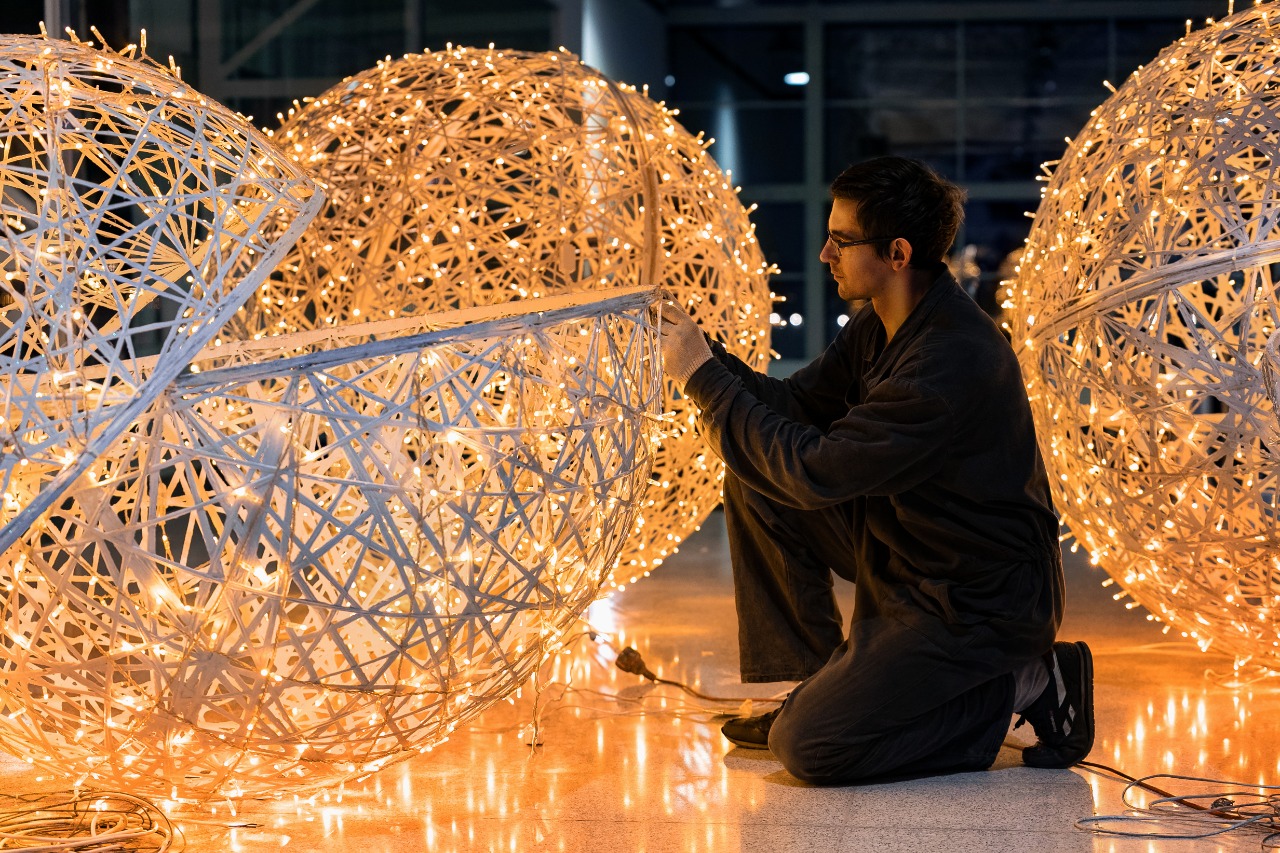
A summer start brings one more advantage, one you only see from the inside. There is time for the meaning. Time to shape an image for this particular centre and its city, in place of a standard tree. Craft won't be hurried: a sphere assembled by hand weeks before the deadline and a detail glued on the night before opening read differently, even in a photograph.
What Remains When the Environment Has Worked
A well-built Christmas works for longer than December itself. Guests' shots spread across social media and, all through January, remind the city of the centre for free. The season earns a reputation as 'the place that's always beautiful', and it carries into the next year, when a family chooses the route again. The operator gains an asset: it draws footfall, time inside and the standing of the address, and it keeps working long after December has ended.
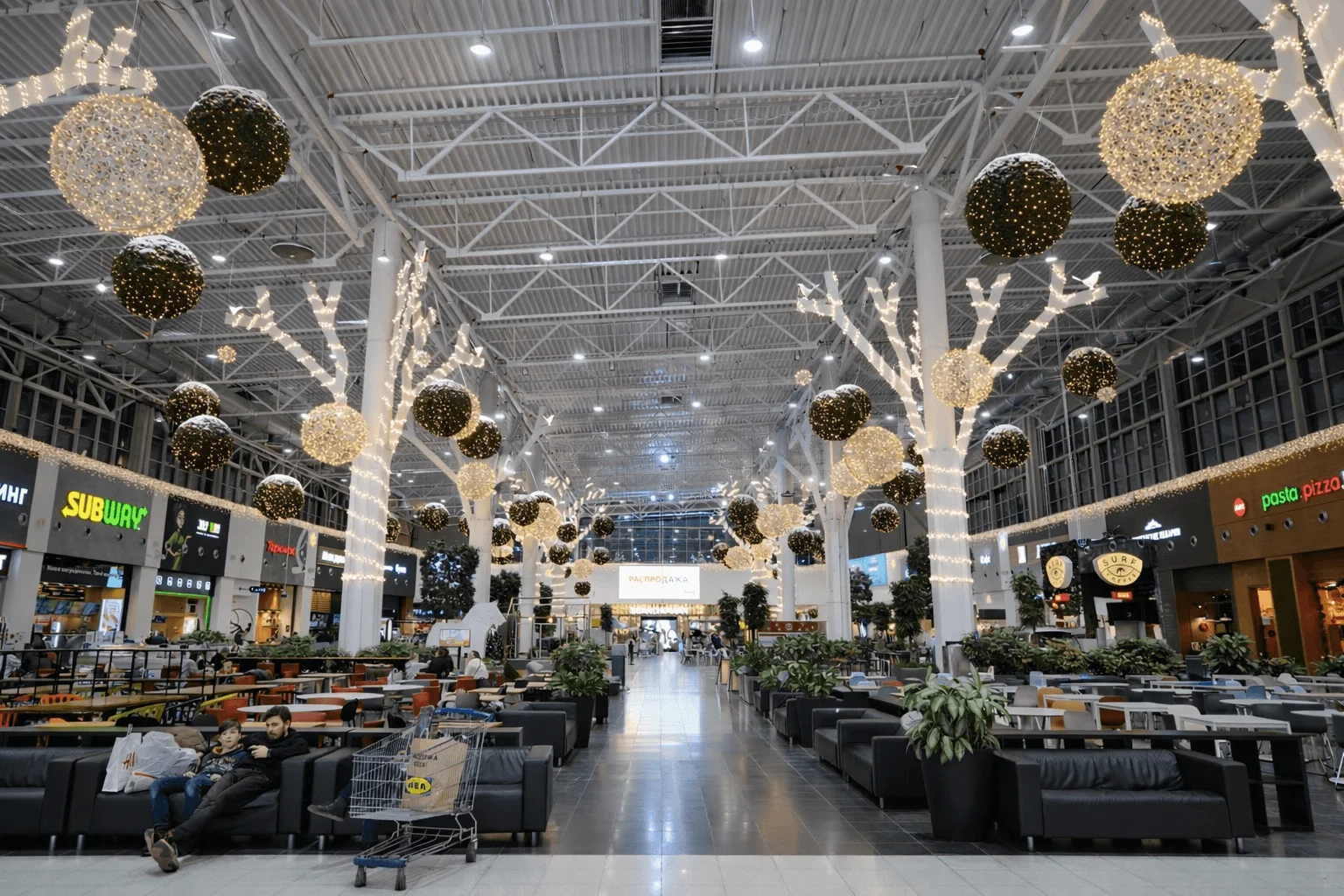
The same arithmetic has another side. A weak Christmas is remembered too. An empty atrium with a catalogue garland tells a guest exactly what it is: no one made an effort here. And that signal travels home with them, into the decision about next December.
Where to Start This Summer
A centre that competes on price and discount every December lives to someone else's rhythm. A centre with an environment of its own sets the rhythm itself, and a neighbour can no longer match it in one season.
From July to Christmas there is exactly as much time as it takes to build the whole environment: from meaning to installation, with one team, to a single standard, and a cost fixed before fabrication begins. A month later, that margin is gone.
The first step is short: a review of your centre. It shows where the atrium loses its character, what image it could hold this winter and where to begin so that December works for you. Get in touch through the site form or message us on WhatsApp - whichever suits.