Shade now has an author
Barcelona runs a shade programme worth €11M and has put its three busiest locations out to competition, with architectural quality written into the brief. All three winning schemes take their form from their own place. That is how shade came to have an author, and with it a different conversation about money.
- Author
- Konstantin Burtsev, ENTORA
- Date
- Reading
- 7 min
- Topics
- public spaces · shopping centres · councils · environment · piece
At three in the afternoon half the square stops working
In summer a square has one half that works and one that does not. People stand pressed against the wall on the shaded side, sit on the kerb under a tree and wait for the bus slightly away from the stop, because there is no room left under the shelter. The benches in full sun stay empty for most of the day, because by midday steel and stone reach a temperature that makes sitting down impossible.
That is how any coastal square behaves between May and September. The owner maintains and cleans the whole surface, and in the hottest hours only the sheltered part is working.
Shade now has its own budget line
According to Barcelona City Council, the city runs a shade programme funded with €11M. The plan runs to more than 200 new shaded spaces in three years, to 2027, plus over 40,000 m² of covered surface. In summer 2026 another 75 locations have been added, among them 38 play areas, 21 public spaces and 16 school courtyards.
Seville, according to its own council, holds a separate awning contract worth €1,703,228.50 over four years, from 2025 to 2029, and adds new streets in the centre every season. Valencia has put its first awnings up over its squares and, until November 2026, is studying which squares and streets get shelter next. Marbella, Ronda, Rota and Alcalá de Guadaíra have all put shade out to tender during 2026.
Awnings have been going up over the pedestrian streets of Seville since 1992, so the idea itself is not new. What is new is the scale. Shade has stopped being a summer measure and become a multi-year programme with a budget, an accountable owner and a handover.
Barcelona wrote architectural quality into the brief
With that money Barcelona could have bought the same white awning for every location and settled the matter with a single supplier. Instead the council has run three separate competitions for the shade structures at its busiest points and has written a requirement for architectural quality into the brief.
All three winning schemes take their form from their own place:
- Portal de l'Àngel, the city's main retail axis. It covers 2,000 m² with a light structure of hexagonal modules drawn from Gaudí's panot, the same paving slab underfoot across Barcelona, reworked in a contemporary language. Due in summer 2028.
- Plaça Comercial, in front of the Born market. It covers 1,400 m² with diamond-shaped canopies gathered into a mesh that follows the geometry of the market's own façade and roof, so that the shade echoes the pattern of the brickwork. Due in summer 2028.
- Passeig Marítim de Sant Martí, on the seafront. It adds 1,600 m² in two pieces, with columns and tensioned fabric that together trace a landscape of light dunes. Due in summer 2027.
Three times running, the public client has turned down the catalogue. None of these structures can be moved to another city, because each is calculated for that address and rests on its material, its geometry and its history. That is why shade has stopped being an engineering service and has come to have an author.
An awning and a piece do the same job on different terms
An awning goes up in May and comes down in September. After that come storage, winter care, inspection of the fixings, replacement of the fabric every few seasons and two installations a year, every year. It is honest and necessary work with a place of its own: the temporary measure in a dense centre where new supports cannot go in.
Add five such seasons into a single line, with their installations, removals and storage, and look at the figure. Then comes a second question. What stands in that square in November? From October to April the place looks exactly as it did before the investment and cannot be recognised in a photograph.
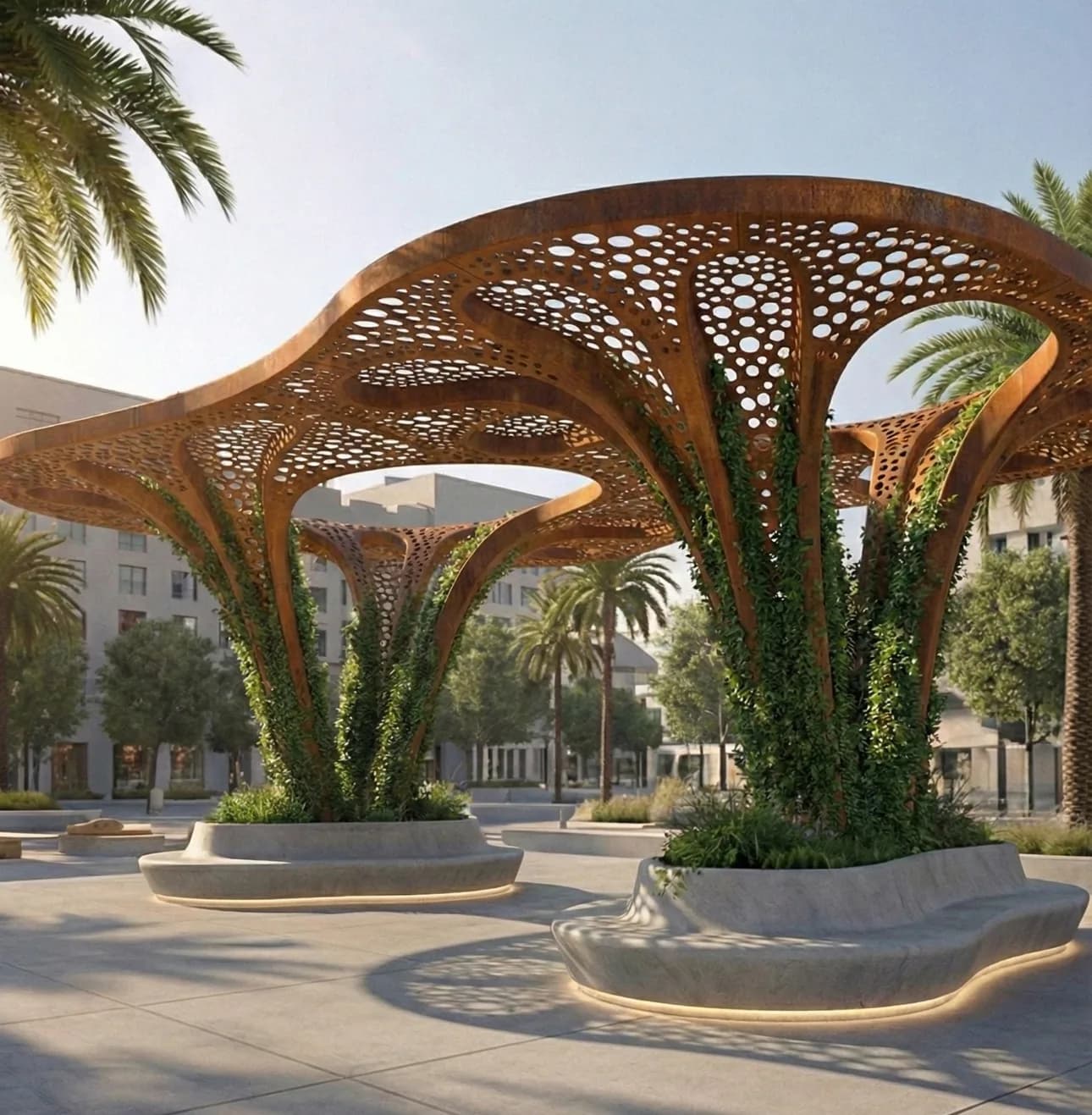
A piece designed for that address works both ways. In summer it gives shade, and for the rest of the year it stays the reference point of the place, the one people arrange to meet at. The money then goes into an item that sits on the balance sheet and stays put once the season ends.
The shopping centre already counts shade in its footfall
According to the Sensormatic Solutions index, footfall in shopping centres rose 2.5% in July 2026 against the same month last year, with the year to date up 4.9%. Among the reasons the company names the summer sales, tourism and the role of climate refuge that centres take on during heatwaves.
Shelter already brings people into the shopping centre. The question is where it ends. The refuge starts behind the glass doors, and to reach them the visitor walks from the car across the baking asphalt of the car park. On that stretch the centre loses the very plan it pays for with advertising: arrive early, walk round with the children, sit outside.
Reading that stretch is the first step we normally take when we start work with shopping centres. We look at where people stop of their own accord and what is missing at those points.
What we learnt on 13,500 m² in front of the entrance
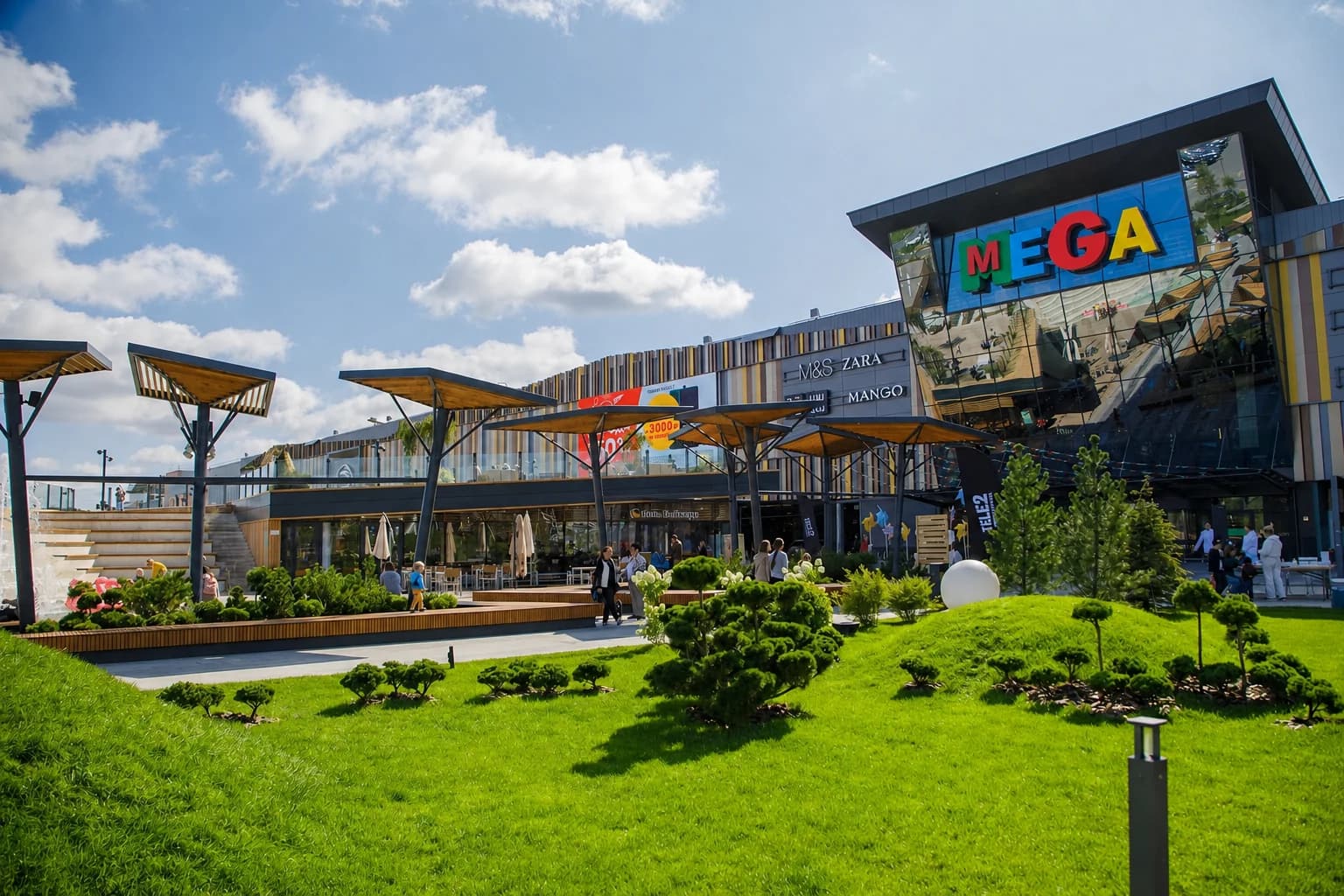
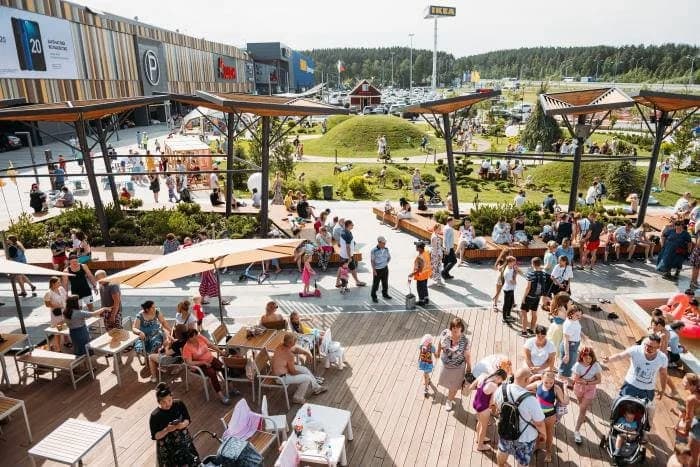
In 2019 we redesigned the strip between the car park and the entrance for an international operator of family shopping centres. It came to 13,500 m² of pergolas, shade structures, loungers, benches, a children's area and architectural lighting. Thermally modified timber, architectural concrete, metal, warm-tone LED. The structures have been in place ever since and are still in use.
The first thing that job made clear is that shelter works at the points where a person already stops of their own accord. Those points are known in advance and without studies: the entrance, the cash machine, the children's area, the bus stop, the queue at a kiosk. A pergola placed for the beauty of the plan, away from them, ends up a good photograph and stays empty.
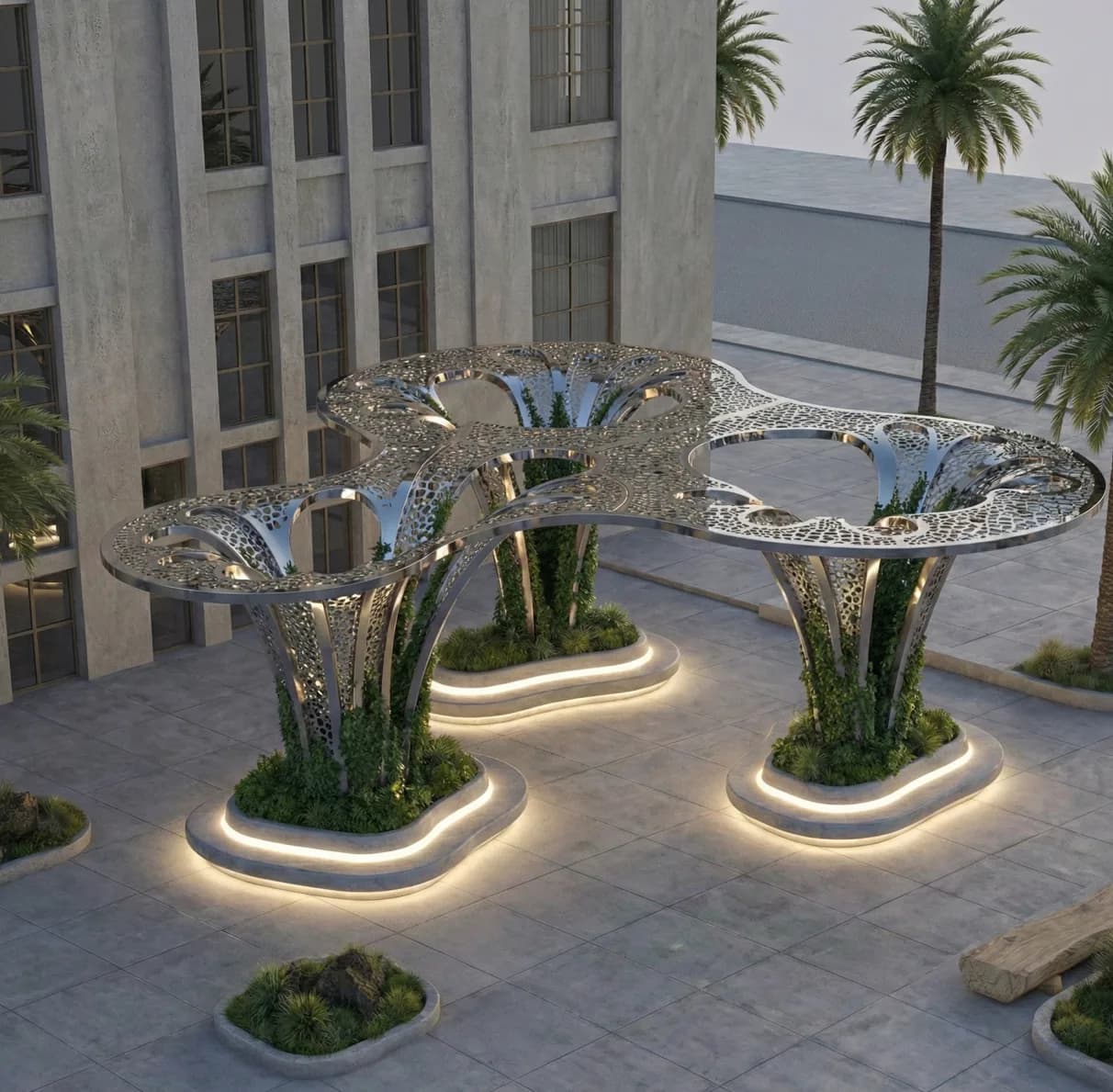
The second is that a shade structure works twice a day. By day it gives shade, and at night it serves as the support for light, with one and the same footing covering both jobs and sparing the square a second set of posts. That is how Janet Echelman's net over Konstablerwache in Frankfurt is built, with the floodlights fixed to the same masts that tension the net itself.
The third is that shade shifts the route more than any signage. People walk on the shaded side even when it means going round, and that is the lever that orders movement across the site.
How long does a piece like this last?
The coast adds salt and ultraviolet to the usual loads. In those conditions fabric lasts years and metal lasts decades, provided the alloy is chosen for that setting and the welds and edges are properly resolved. That is why the difference in service life eats the saving made at the outset. With a structure that has to be replaced after three seasons, the investment never comes back.
What exactly we choose for pieces by the sea, and why, is set out separately in the piece that only asks for a wash.
The square has already shown where it needs shade
People mark out the pattern themselves, and it can be read without measurements: the strip of worn ground along the wall on the shaded side; one bench occupied out of six, and precisely the one under the tree; the café chairs the waiter moves to the other side of the terrace by midday; the queue that has shifted left of the door, under the canopy.
Walk your site in July, at around three in the afternoon, and mark those places on the plan. Three questions follow. What stands at those points in November, and would you recognise your own place in a winter photograph? Whose form does your structure follow, the supplier's catalogue or your address? And does that structure hold the evening light itself, or will separate posts have to go up for the lighting?
Where to start
Barcelona ran its competitions long before the summer when people will actually stand under that shade, with handovers set for 2027 and 2028. Between the decision and the first working season lie 18 months to two years: the competition, the design, the consents, fabrication and installation. That is the horizon a commission like this is measured against, and it explains why shade is commissioned in the cold months.
It all starts with a reading of the site. Where the middle of the day is lost, which stopping points have already formed on their own, and what piece the place can carry through the 12 months of the year. How we work with cities and public spaces is set out on the sector page.
Write to us through the form or message us on WhatsApp, whichever suits you.