The Piece That Only Asks for a Wash
316L stainless steel, PVD colour, electropolishing. Why we choose the most resistant metal that makes sense and the most proven technologies - and what that gives a council or a shopping centre.
- Author
- Konstantin Burtsev, ENTORA
- Date
- Reading
- 8 min
- Topics
- materials · engineering · durability · councils · shopping centres
By the third year, it all shows
When a council, or the owner of a shopping centre, takes delivery of a piece in a courtyard, a square or the atrium, everything looks fine. The piece is new, the metal shines, the colour is even. At that point the difference between a good material and a poor one doesn't show. It shows neither in the render nor at handover.
The difference appears in the third year. Cheap steel by the sea shows its first rust spots along the welds. Painted metal fades on the sunny side and starts to flake at the edges. Streaks appear that no longer wash off. From there it stops being about looks and moves to the running-cost budget: repainting, corrosion removal and, sometimes, taking down a piece that has lasted three seasons when it should have lasted fifteen years.
A council and a shopping centre are buying how the piece will look in ten years and how much attention it will ask for in that time. The answer to both is settled in the choice of material and in what we do to it before it reaches site. On site and in the design, there is no longer any room to change it.
Why steel, and why 316L in particular
There are many stainless steels, and the difference between grades decides everything for a piece left outdoors. The most common architectural stainless is grade 304. It works well indoors and in a dry climate. By the sea it gives up. The air of a coastal city always carries chlorides - the salt the wind brings off the water. Chloride is the main enemy of stainless steel. It attacks the protective layer with pitting corrosion, and on 304 you see it within a couple of winters.
We work in 316L stainless steel. What sets it apart from 304 is molybdenum, present in 316 at around 2-3%. Molybdenum sharply raises resistance to pitting corrosion, precisely in a chloride environment. In metallurgy this is measured by the PREN, the pitting resistance equivalent number. On 304 it sits around 18-20; on 316, around 24-26. Put simply: by the sea, 316 holds off the salt where 304 has already rusted.
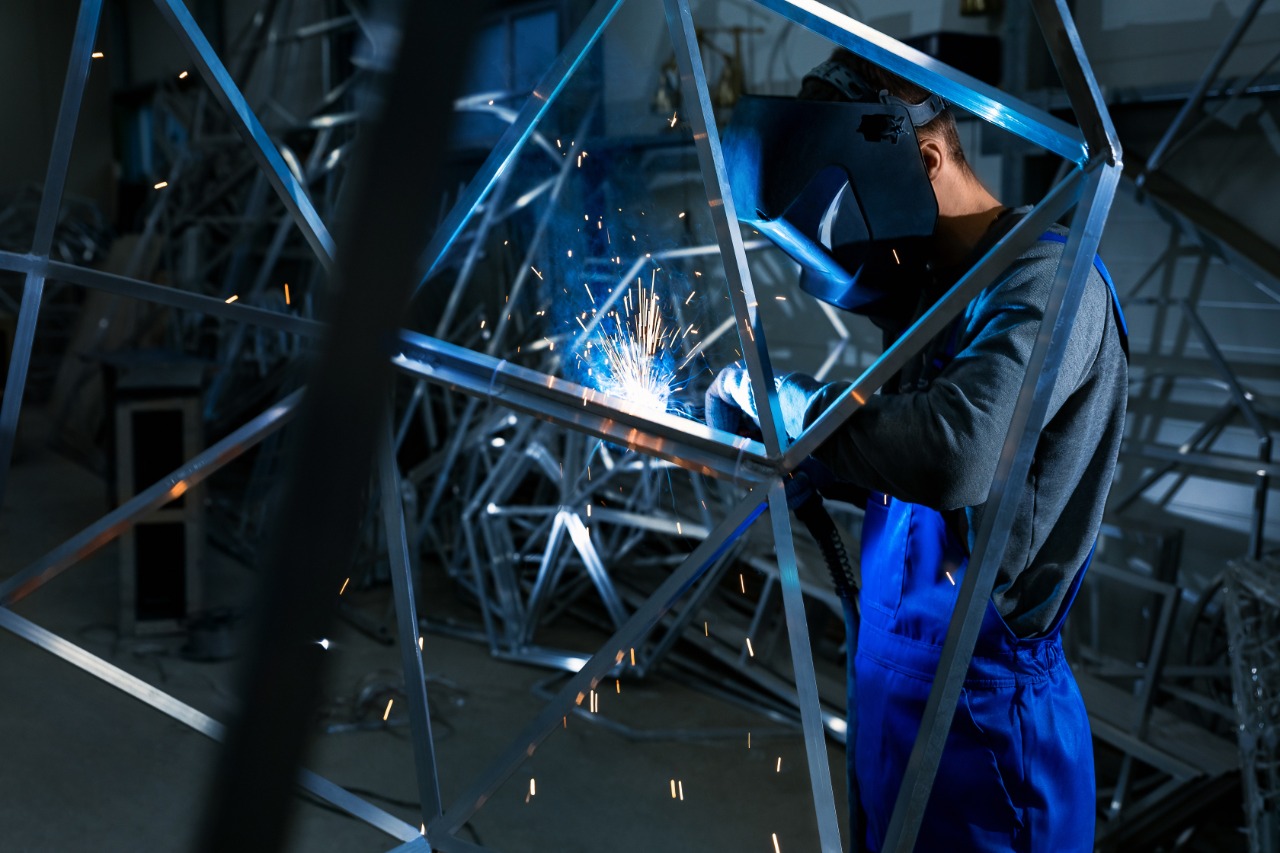
The letter L stands for low carbon - no more than 0.03%. It sounds like a detail, but it is about welding. Every one of our pieces is a welded structure, and the weld is its weakest point. When you weld ordinary steel, chromium carbides precipitate along the grain boundaries of the weld. That zone loses chromium and starts to rust along the seam - exactly the rust line of the third year. The low carbon in 316L removes the cause. The weld stays as resistant as the rest of the metal.
For a piece in Valencia, Barcelona or Alicante, this is no fine point for engineers. It is a direct question of service life. By the sea, 304 keeps the maintenance team on edge; 316L looks after itself.
Polishing that works for durability
Choosing the right grade of steel is half the job. The other half is the surface treatment. Here we do something expensive and invisible that, in fact, decides how the piece will come through ten years of salt and rain.
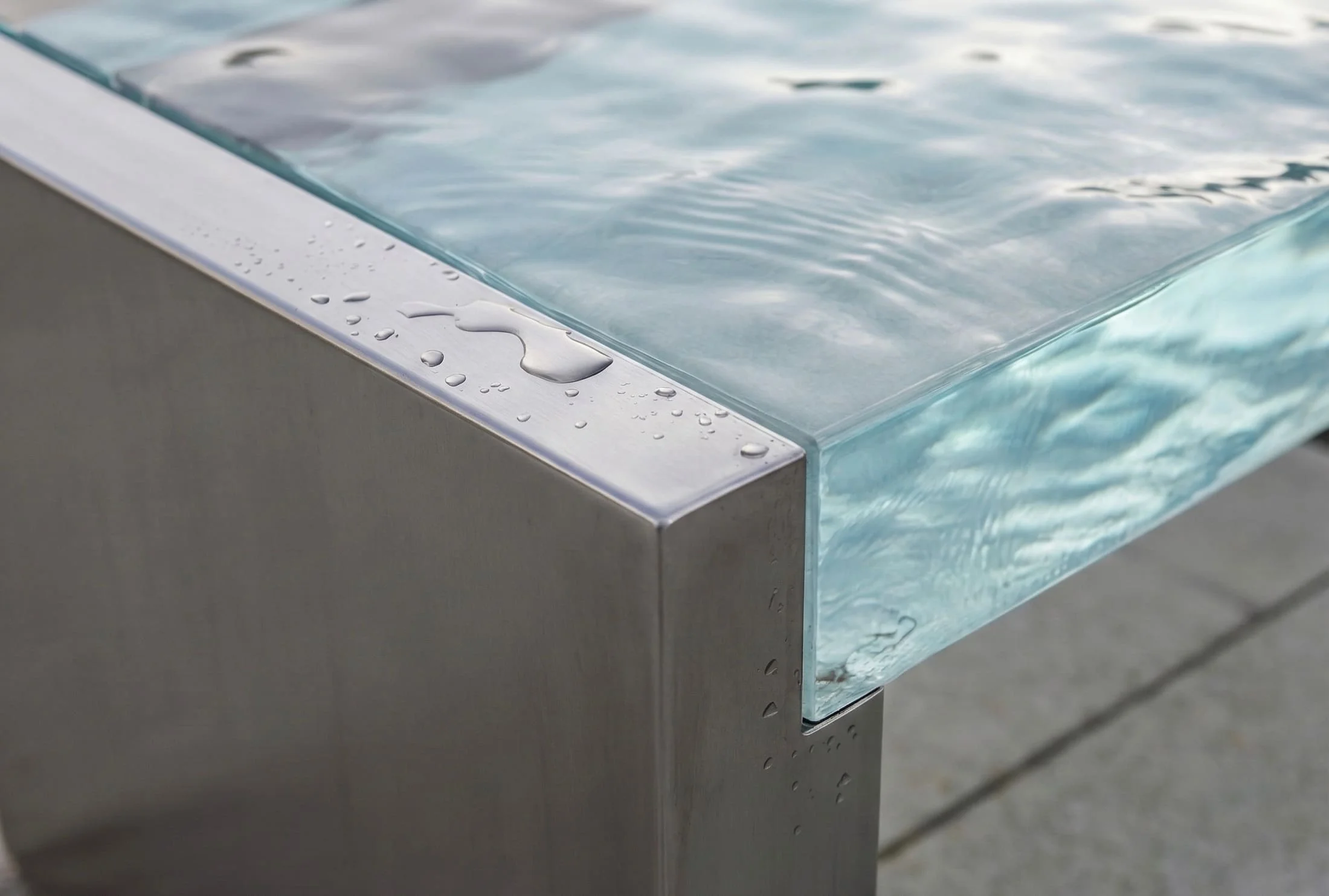
We electropolish the surface. It is dearer and more involved than a plain bright polish. Electropolishing is an electrochemical process: the piece is immersed in a solution and a very thin layer of metal, a few microns, is taken off the surface. Here is what that gives:
- Dirt goes at the metal's own level. Free iron and micro-inclusions left after cutting and grinding are removed. On ordinary steel, the first corrosion takes hold in exactly those spots. After electropolishing, rust has nowhere to start.
- The surface becomes smooth at the microscopic level. Roughness drops several times over. On a mirror-smooth surface, salt, dust and water find nothing to cling to. Dirt doesn't build up, and the rain carries it off on its own. The piece stays clean longer without hand-washing.
- The protective layer becomes even and dense. Stainless steel is protected by an invisible film of chromium oxide a few nanometres thick. Electropolishing makes that film uniform across the whole surface. We also passivate the metal, treating it with an acid that restores and reinforces the layer to ASTM A967.
The result of the three operations is a steel that gives salt spray nowhere to take hold. The same logic is used in medical equipment and marine hardware, where a material failure is not an option. We bring it to a piece that stands on the seafront.
Colour grown into the metal
When a piece needs colour - gold, bronze, graphite or black - there are two routes. The easy one is to paint it. The right one is to apply a PVD coating.
We never use paint on outdoor pieces. Paint sits on top of the metal like a film. The sun burns it, temperature swings crack it, the edges flake, and sooner or later it has to come off and go back on. For a piece meant to last fifteen years with no upkeep, that is a dead end.
PVD - physical vapour deposition - works on a different principle. In a vacuum chamber, a very thin ceramic layer, a fraction of a micron, is deposited onto the steel. It bonds with the metal at the molecular level. The colour is set by the composition of the layer: titanium nitride gives gold; other compounds give bronze, graphite or black.
What changes in practice:
- It holds its colour. PVD colour is a property of the ceramic layer itself. There is no pigment for the sun to burn, and at ten years the tone is the same.
- It resists scratches. The ceramic layer is several times harder than the steel. Keys, sand, a stray knock - where paint would have come away, PVD holds.
- It works with the steel against corrosion. The dense ceramic layer is an extra barrier over the already resistant 316L.
A gold piece in paint and a gold piece in PVD look almost the same on installation day. Three years on, the difference between them is stark.
Backing what's proven
This is where it is easy to go wrong. There is always a newer material on the market, a more exotic coating, a technology that makes a good story. We deliberately don't go that way.
Our principle is the highest grade of metal that makes sense and the most durable of the proven technologies. The proven ones, precisely.
316L, electropolishing, passivation and PVD left the experimental stage long ago. These are solutions that industries have relied on for decades, in fields where a material failure costs too much: marine engineering, medicine, watchmaking and façade architecture. Their service life is known, predictable and proven well before the metal ever reaches our piece.
A council puts a piece in a square for fifteen years; a shopping centre, for the length of the lease. They need a technology with known behaviour at year ten, and we don't experiment on the client's piece. The exotic has no service history yet, so it offers no predictability either. We take the top of the range among the solutions that already have that history.
This is engineering maturity: choosing the solution with the longest service life and a known risk.
What this adds up to
It all comes down to something simple. The piece on installation day and the piece at ten years look the same.
What that means for whoever keeps it in service:
- Zero repaints over the service life. There is nothing to refresh; the colour lives in the metal itself.
- Maintenance is a normal wash. No corrosion removal, no coating repair. The passivated, smooth surface is largely washed by the rain.
- The photogenic quality holds for years. A piece that works as a draw and a photo backdrop in a public space stays the very image it was placed for.
- A clean running-cost budget. The line for restoring the piece, the one every maintenance team dreads, simply isn't there.
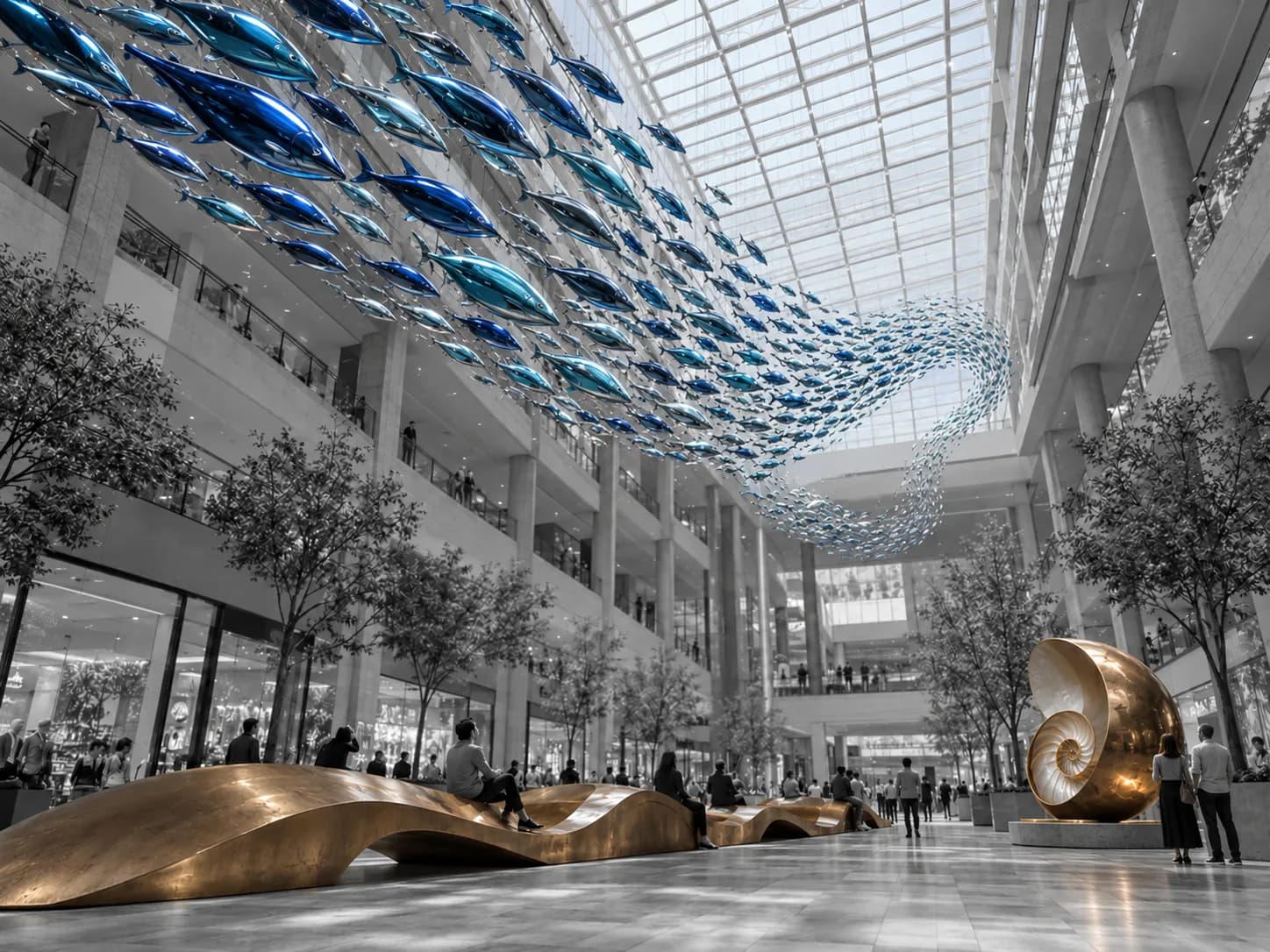
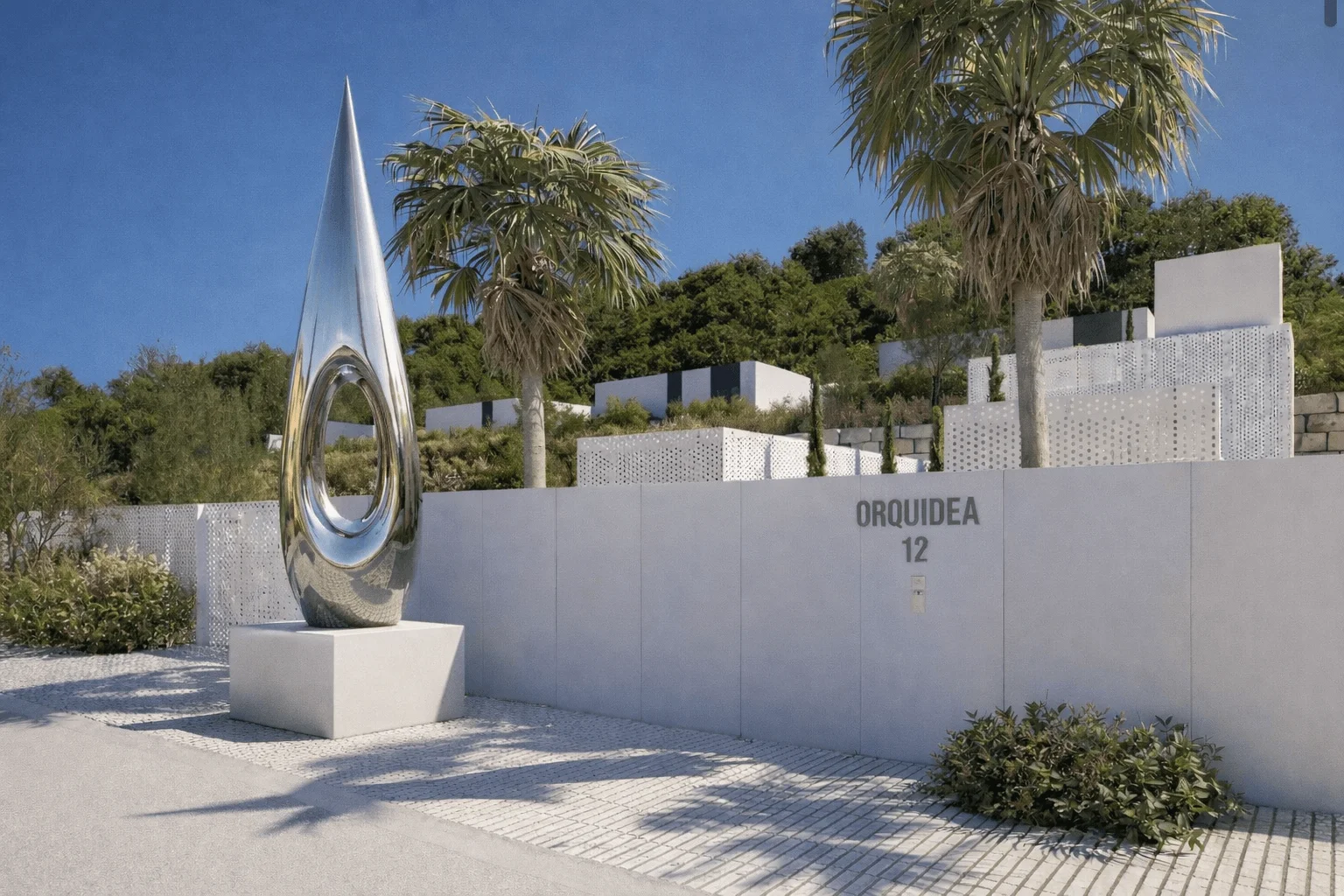
We have installed a mirror-finish series in 316L stainless steel in a public space: the piece comes through winters and rain with no maintenance beyond washing, and holds its look from day one. The benches and street furniture that have stood outdoors for years, in a garden and along a route, show the same.
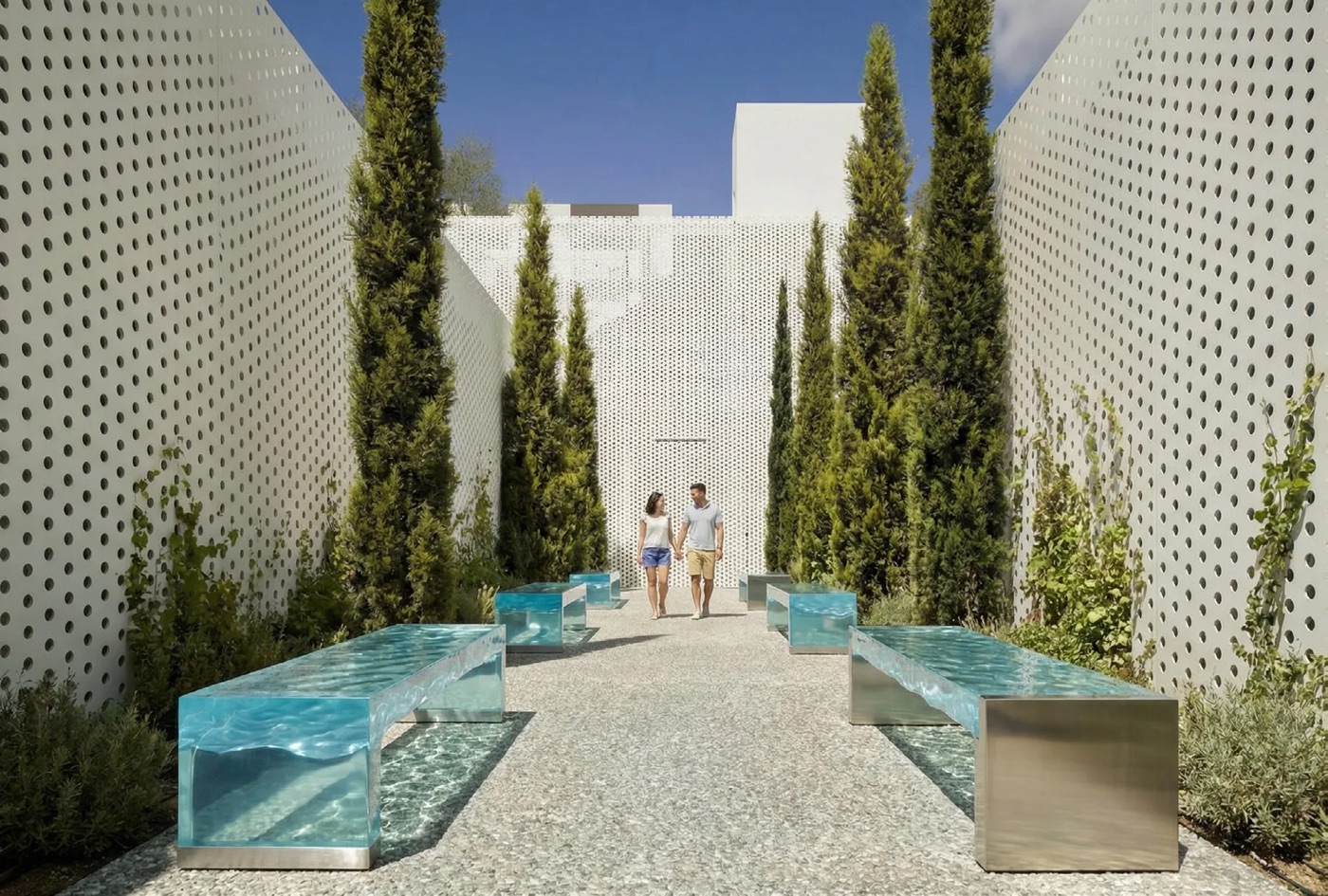
This is what councils and shopping centres value. They value the peace of mind: the piece goes in and you can forget about it. It will see out its service life and, all that time, look worth what it cost.
How this lands in the project budget
The material and its treatment are part of the engineering we develop alongside the concept and the design. At that stage everything is on the table: what the piece is made of, how it is treated, its estimated service life and what it will cost to maintain. The budget is fixed before fabrication starts. On site, exactly what was approved goes in, with no surprises.
A cheap material saves at the outset and hands that saving back in invoices in the third year. A resistant material costs more once and then asks for nothing. For a piece that stands in a square or an atrium for years, the second option is almost always cheaper over the whole service life.
In the analysis what the first few seconds decide we look at how it works in a space and what it does for the business. Here we look at what it is made of.
Where to start
A piece that asks for maintenance is a piece where the saving was made on the material. A piece you can forget about for ten years rests on three decisions: the grade of steel chosen, the micron taken off in electropolishing and the colour grown into the metal.
We take on the whole route. Concept, design, engineering, fabrication at trusted European facilities, installation and handover. One contract, one point of responsibility, one material standard, from the first sketch to the piece in a city square or a shopping centre.
The first step is an analysis of your project. It shows where the space loses character and where to begin.